

Extreme Reading for the Restless Mind
What my summer of wild books taught me about travel, attention, and the value of discomfort.

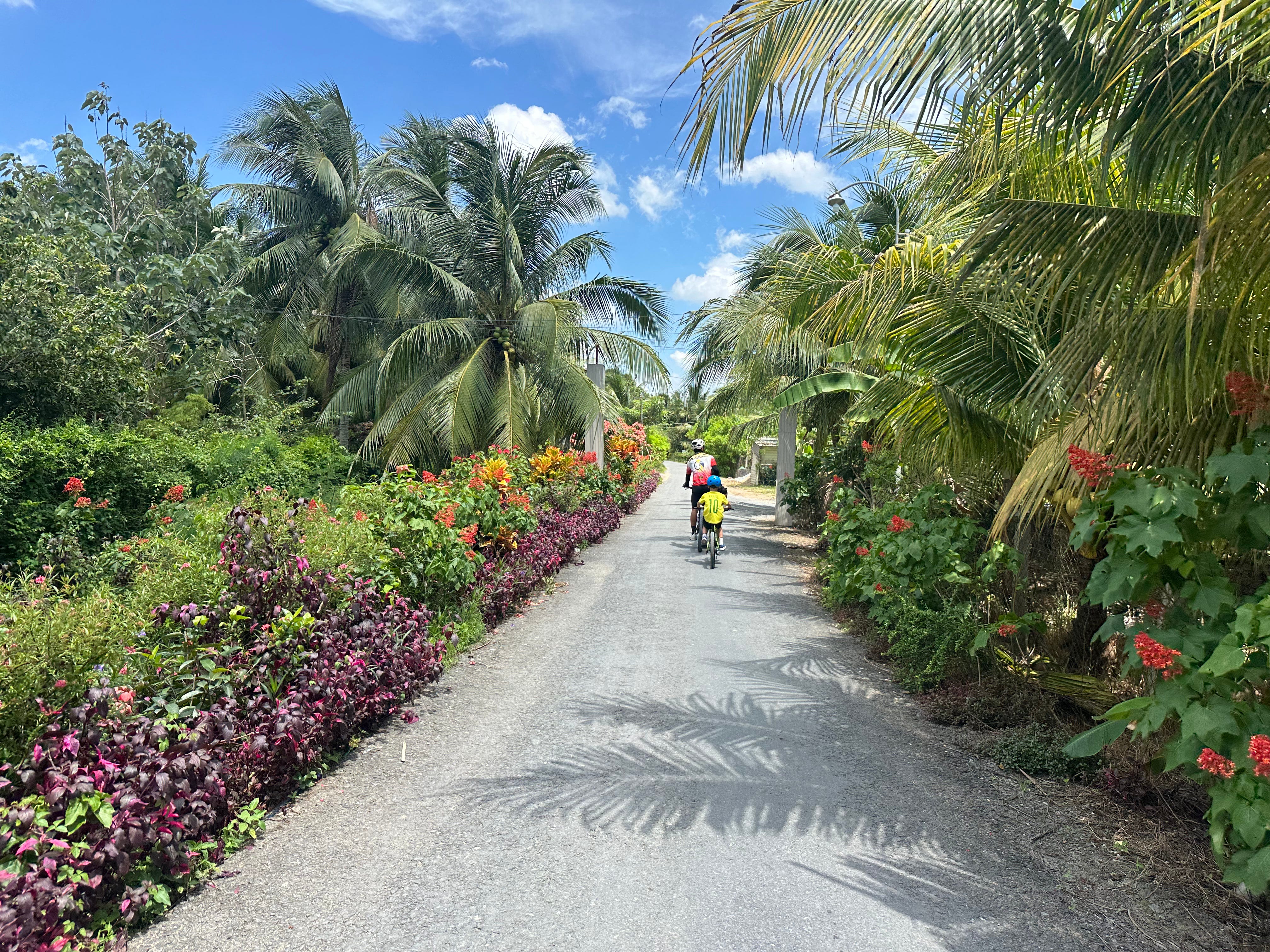
Because I am an educator, I live in a perpetual state of oscillation between a “school year” and a “break” mentality – a key feature of the profession. And the reader in me knows that summer break is the most significant break when it comes to my reading life. And thus, each year, come early-June, I carefully craft a reading list; this is a task that brings me much joy. A formula I have used in the past is: one giant classic (the likes of which I would never have time for during the school year…Anna Karenina is one example), a couple of nonfiction titles (education or parenting related, often), and a stack of literary titles (a few novels, some poetry, a memoir, perhaps). When I can, I seek to find the exact right book to compliment the particular locale and backdrop of the season. A particularly on-the-nose choice: a memoir about biking through Vietnam, which I paired with our family’s own cycling trip through the Mekong Delta. Perhaps you do something similar with your curated list?
This summer, my family and I stayed in Asia, where we live. A somewhat daring move by international educator standards in the sense that we chose not to return for the month of July to Seattle and San Diego, where our families live, but instead, to remain based in our home in Bangkok, do a bit of regional travel, and experience a summer akin to that of many other families around the world whose children have several weeks off school. We chose to stay home. That is to say, we stayed in Asia. We embarked on several wonderful journeys: Vietnam by bike, Hong Kong with our wide-eyed almost-seven-year-old experiencing Disneyland for the first time, and got more acquainted with the circuitous back alleys of downtown Bangkok.
Settling back into our apartment in the northern suburbs of Bangkok, hearing our neighbors voices once again as, little by little, they return for another school year, I am looking back on the strange summer reading I did this year. It has revealed a thirst for a travel of another sort: the kind that happens when someone else’s journey, detailed in the pages of a book, takes you someplace you are certain you will never go. I realized, in hindsight, I had been seeking the kind of reading that is supremely immersive and genuinely adventuresome.
This summer, I’ve been reading about extreme travelers.
In the books I chose (genuinely not seeing the link between them at the outset), the characters paddle, pedal, orbit, and freeze in motion, pushing the boundaries of both geography and themselves. Somewhat by accident, I spent the whole summer reading about wild, unglamorous, beyond-the-pale adventures that take the form of memoir, travelogue, and novel. And whilst I won’t go so far as to align myself with the thesis of the provocative New Yorker piece “The Case Against Travel” by Agnes Collard, I do believe travel is an ethical quagmire, full of tensions and questions worthy of our attention. One such issue is the much sought-after “authentic” experience, made more fraught by the pursuit of the perfect Instagram post. This has created a strange and surreal backdrop for just about any vacation destination today. So whilst I will stop short of maligning travel in general, I’d like to recommend reading the kind of literature wherein people (both real and fictional) are truly engaging in a travel experience worthy of being called “authentic”; a kind of travel that eludes most of us today.
Here are four books that transported me to the outer edges of experience and reminded me how incredibly close we can get in 2025 to a meaningful travel experience simply by cracking a book.
1. The Happy Isles of Oceania by Paul Theroux | Nonfiction Travelogue
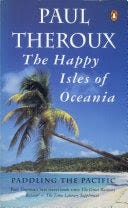
Lesson: Curiosity > comfort.
Globally-renowned travel writer Paul Theroux kayaks solo through the scattered islands of the Pacific after the collapse of his marriage. Theroux’s lens is undoubtedly cynical at times. Of course, he is dragging a collapsible kayak through the jungle sleeping in a tent for much of the book, but it is true: he sees things with brutal, sometimes uncompassionate eyes. And yet, what strikes me is the way he describes people and places that are nearly impossible to encounter by the average traveler. Like a good reporter, his questions are frank and simple. His ability to show up in remote places, ask genuine and curious questions, and have the diligence to record the responses was what kept me interested. He lives alongside villagers for weeks at a time, hears of colonial ghosts, and critiques tourism’s shallow mimicry of connection. His journey is as much about estrangement as it is about place; and he’s honest about how broken he feels at different points throughout his 18 month sojourn. He asks us to come face to face with the stark realities of places we often think of as exotic and pristine and recognize the myth of those associations. The reality is much more grim. There are Portuguese man-of-war stings, shark sightings, ancient ruins, narrow escapes, tales of truly uncanny and terrible living conditions and insights into the sad realities facing many places that are not able to preserve their traditional culture in the face of tourism and modernity. Theroux takes us along for the ride; and, personally, I have never read anything like it.
Quote: “A traveler has no power, no influence, no known identity. That is why a traveler needs optimism and heart, because without confidence travel is misery.”
2. Arctic Dreams by Barry Lopez | Nonfiction Travelogue
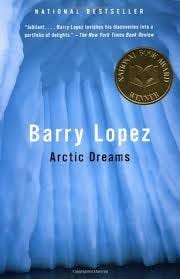
Lesson: True travel is reverence.
If you are the kind of person who loves the sound of David Attenborough’s voice or the swoony sweep of a barren landscape filling your TV screen, you will find your happy place in these pages. It reads like a filmed nature documentary with uncanny similarity. I imagine the audiobook must be mesmerizing. (I read it in print).
Filled with humanity and eager interest in nature, Lopez’s writing is as compassionate as it is beautifully constructed. His attitude is humble and aloof. He doesn’t conquer the Arctic; he studies it. He doesn’t position himself as central. Rather, he fades into the landscape, letting ice, light, and animals take narrative priority. This book is one of the most enrapturing works of literature I have encountered on the subject of a specific landscape. Much like an ode, you can sense the respect the author feels for the place and its inhabitants. And in keeping with the theme, it was another reminder of the limits adventure seekers go to experience a wild place. This book reminds us of the values of restraint, humility, and the radical act of not interfering. It will soothe your mind as you drift off to sleep.
Quote: “I looked out over the Bearing Sea and brought my hands folded to the breast of my parka and bowed from the waist deeply toward the north, that great strait filled with life, the ice, and the water. I held the bow to the pale sulphur sky at the northern rim of the earth. I held the bow until my back ached, and my mind was emptied of its categories and designs, its plans and speculations. I bowed before the simple evidence of the moment in my life in a tangible place on the earth that was beautiful.
Catfish and Mandala by Andrew X. Pham | Memoir
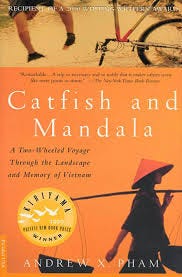
Lesson: Movement can be a form of mourning.
Pham’s journey is the most personal of the four. His memoir details an arduous attempt to bike across Vietnam as a Vietnamese-American (Viet-Kieu) grieving the loss of his sister. The terrain is both literal and psychic. He’s a foreigner in his birthplace, a witness to war’s long shadow, and a critic of both American and Vietnamese assumptions. No details are spared. This kind of perspective is the true opposite to the curated travel mood board on Pinterest. Nothing is beautiful, everything is complex, often filthy, shown without any attempt to gloss it over. Pham doesn’t give us the “exotic” Asia of our imagination at all, but asks his readers to bring attention to the troubles, quirks, and contradictions of a place, rather than admire its quaintness or unquestioningly see it as “beautiful”. He allows us to dig deeper, because that’s his project too. His travel is not redemptive; rather, it’s unresolved. This book reminds us that sometimes, no matter how hard you try to be an insider in a place, there are always shades of grey to belonging. When we’re visitors, even in the case of those with shared ancestry and heritage, we always remain somewhat outside the experience of the actual inhabitants of a given place.
Quote: “Too many things have changed. Too much time has passed. I’m different now, a man with a pocketful of unconnected but terribly vivid memories. I was looking to dredge up what I’d long forgotten. Most of all, I am wishing for something to fasten all these gems, maybe something to hold them in a continuity that I can comprehend.”
Orbital by Samantha Harvey | Novel
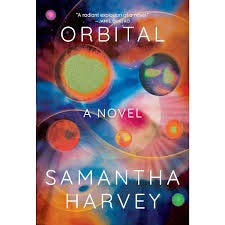
Lesson: Distance from the known can be the catalyst for unexpected wisdom.
This quiet novel is set aboard the International Space Station, unfolding over the course of one Earth orbit. It is the most “extreme” journey, the setting being outer space. And yet, it is the most intimate. Harvey’s writing zooms in on small gestures: a floating fork, a shared glance, a strange nightmare experienced from a hovering sleeping bag suspended in zero gravity. Much of the novel centers on the dissonance between the majestic nature of the outer-space experience. The view of the earth’s landscapes, landmarks and weather from miles above the panorama of the sun and stars, and the psychological experience of being transported away from the earth and into the sky – “above it all” gives the characters a kind of superhuman experience, which is contrasted sharply against descriptions of paltry, microwavable meals, extreme close proximity to other passengers for months on end, and a lengthy separation from loved ones and routines. Like the other books on the list, the travelers have willingly sacrificed a great deal of comfort in exchange for the experience, no doubt hoping to bring something meaningful back to humanity upon their return. Oh, and the writing is blissfully gorgeous!
This book reminds us of what must be sacrificed (and what is gained) when we choose to go places almost no one has gone before.
Quote: “Maybe human civilization is like a single life – we grow out of the royalty of childhood into supreme normality; we find out about our own unspecialness and in a flush of innocence we feel quite glad — if we’re not special then we might not be alone.”
…
In 2025, travel narratives are everywhere. We watch each other board planes on Instagram, sip coffees in different time zones, and post temples and trails with captions about “living fully.” The images being telegraphed have never been more curated and, perhaps, never more…misleading. It’s OK that most of us will ever go to space or spontaneously wash up to the shores of a Melanesian island village and set up camp on the beach for an indeterminate amount of time, subsisting on canned mackerel and coconuts. We will much more likely snap a selfie of our toes featuring a blurred background of a busy beach full of people looking at their phones from their chaise lounges and capturing not-too-dissimilar photos from those of their adjacent neighbors.
And even if you are the kind of intrepid traveler of the aforementioned pages – (impressive!) – do we document our journeys as diligently or artistically as they? Do we encounter the place in any close approximation as a person who actually lives there does? I’ve been pondering how rare it is that our deepest, most profound travel moments are captured and conveyed with fidelity. And what’s more, I’ve begun to question the entire thesis of experiencing a place as it really is. How can we ever really enter into a foreign place and make sense of it?
Reading these extreme adventure books can offer something of a corrective and a path forward. They remind me that there are people who have traveled more intrepidly, more dangerously, and with more discomfort and intention than most of us ever will. People who have carried grief across continents, who have sat still in unbearable cold awaiting some silent natural phenomenon, and people who’ve catapulted around the Earth in endless, repetitive circles in the close quarters of a spaceship.
These travel tales give us a window into something decidedly unfiltered and full of friction. I found myself captivated by the way they weren’t appealing to any luxurious travel sensibilities and certainly not achieving a marketable aesthetic. If these stories share anything, it is the quality of rawness, of sharing the darkest and most miserable moments experienced in transit. Pham spends much of his narrative experience suffering through bouts of diarrhea and illness, whilst attempting to ride his bike through the dizzying roads of Vietnam. Lopez’s tales from the Arctic come to us from his camp on the sea ice – weathering the inescapably bitter cold. Theroux, at one point on his journey, must visit a weatherworn medical clinic seeking a remedy for a painful and deeply undignified ailment. The cosmonauts tell of gathering loose hairs and nail clippings to keep their airtight vessel clean. The writers of these books seem almost to be testing our strength as readers. Can we really tag along without looking away, they wonder?
And what’s more, I found another link between these tales. They’re about people moving through the world nearly or completely alone – often out of sync with those around them. The figures in these stories reject conquest in favor of attention. They model an ethical kind of wandering that feels elusive in an age when attention can be a commodity and travel can feel like a performance.
Reading these books gave me a sense of myself and my smallness in the context of an endless, unknowable universe. Here’s to summer reading that takes us somewhere wild and terrifying…from the safety of the chaise lounge.
❤️Quote: “A traveler has no power, no influence, no known identity. That is why a traveler needs optimism and heart, because without confidence travel is misery.”
I read Catfish and Mandala years ago and loved it! It is Very very high on the 'Goblin Index'.